 info@kafatabanidernegi.org
 Türkçe
 English
A patient saved by early-warning AI has made medical history.
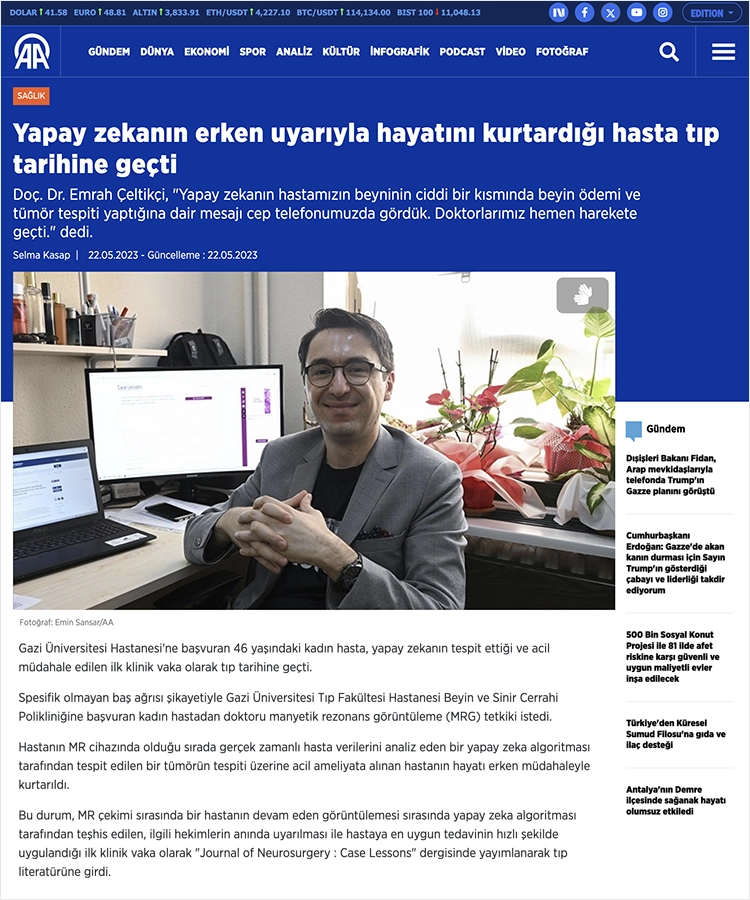
Associate Professor Dr. Emrah Çeltikçi stated, “We received a message on our mobile phones indicating that artificial intelligence had detected brain edema and a tumor in a significant part of our patient’s brain. Our doctors immediately took action.” The 46-year-old female patient who applied to Gazi University Hospital became the first clinical case in medical history to receive urgent intervention based on an AI-detected finding.
The patient had visited the Neurosurgery Outpatient Clinic at Gazi University Faculty of Medicine with complaints of nonspecific headaches. Her physician requested an MRI scan.
While the patient was in the MRI machine, a real-time artificial intelligence algorithm analyzing patient data detected a tumor. The patient was immediately taken for emergency surgery, and her life was saved thanks to the early intervention.
This case was published in the journal Journal of Neurosurgery: Case Lessons as the first clinical report in which an AI algorithm identified a condition during ongoing MRI imaging, instantly alerted the treating physicians, and enabled the rapid application of the most appropriate treatment. It has now entered the medical literature as a landmark case.
Algorithm Training Took Six Months
The details of the study were shared with an AA correspondent by Associate Professor Dr. Emrah Çeltikçi from the Department of Neurosurgery and Professor Dr. Şeref Sağıroğlu, Project Director of the Turkish Brain Project at Gazi University.
Dr. Çeltikçi, a specialist in brain tumors, pituitary, and skull base surgery, stated that as part of the Turkish Brain Project, which started in February 2021, training the algorithm with data related to neurosurgery, such as “stroke,” “bleeding,” and “tumor,” took six months.
He explained that they subsequently conducted studies on real patient data, completed the second version of the algorithm, and began running it 24/7 on MRI machines at Gazi University Hospital.
Dr. Çeltikçi added that the newly developed AI models were integrated into the hospital automation system where the MRI images are recorded. This allowed the AI algorithm to evaluate, within 5–10 seconds while the patient was still in the MRI machine, whether the brain MRI contained any abnormalities.
With the support of the Digital Transformation Office, the AI system was integrated into the video messaging service of a mobile operator. Dr. Çeltikçi said: “Thus, when the algorithm detects an abnormality on an MRI, it sends a message to the doctors’ mobile phones via a specially developed service. The anonymized image containing the abnormality is also delivered to the doctors. The AI system highlights (segments) the abnormal regions in the MRI slices of the patient.”
Since its implementation, the AI algorithm has been sending alerts directly to doctors’ phones. Speaking about the patient who made medical history, Dr. Çeltikçi said:
“It was in the evening. Our patient, who came to the outpatient clinic with a headache, was requested to have an MRI. The AI system detected an abnormality while the patient was still in the MRI machine. When we checked the phone, we saw a message indicating that the AI had detected brain edema and a tumor in a significant portion of the patient’s brain. Our doctors immediately took action and implemented the necessary measures. According to the biopsy we performed, the patient was diagnosed with a brain tumor and treatment began.”
Dr. Çeltikçi emphasized that the number of MRI scans in Turkey is very high, and the time required for radiologists to review these images varies from hospital to hospital. He said: “AI was able to indicate the abnormality requiring urgent intervention in a very short time. The intended purpose of AI is to function as an early warning system.”
He also stated that future AI studies aim not only to provide early warnings but also to identify the tumor type and its genetic characteristics.
“Our Patient Became the First Case in the World Literature”
Emrah Çeltikçi pointed out that artificial intelligence studies are being conducted in European countries and the U.S., and offered the following assessment:
“We have not seen a real patient intervention identified by a real-time working algorithm in the literature. Honestly, this situation surprised us. Looking back, we realized that, for example, early-warning systems developed in the U.S. have not yet received FDA approval. Therefore, they do not have the capacity to test such a situation in real-time. Bureaucratic barriers there also prevent this. Moreover, because the U.S. healthcare system is private, access to data is limited. This situation worked well for us. Our patient became the first real patient in the literature whose MRI was taken the day after being detected by AI and who received immediate intervention. We even published this. Our patient became the first case in the world literature. This was a real patient, not experimental; the patient underwent an MRI, AI detected the brain tumor, alerted the doctors, and the patient received treatment. We are very proud and happy about this. After all, being the first to do something is always special.”
Çeltikçi explained that the early detection of the brain tumor by AI allowed urgent intervention before radiologists even had a chance to report the MRI results. He noted that their hospital could use the AI system specifically for the early detection of “stroke” risk in the emergency department.
“An Exemplary Project for Our Country”
Professor Dr. Şeref Sağıroğlu, Director of the Gazi University Center for Artificial Intelligence, Big Data Analytics, and Security, and Principal Investigator of the Turkish Brain Project, stated that the project is the first in Turkey to be based on an open-data philosophy and usable in real-world settings.
He explained that up to 30 researchers, including Gazi University faculty, researchers, and the team from the Presidency’s Digital Transformation Office, contributed to the project at different times. Sağıroğlu continued:
“We processed the data we obtained in compliance with the Personal Data Protection Law and anonymized it. Using MRI data in a research project is very difficult, but we succeeded. We used the dataset we produced in our research and to train AI models, developing a product that doctors can use. We anonymized the MRI data and made it available to researchers. This is an exemplary model for our country. We are extremely pleased that one of our studies, demonstrating that AI models can detect tumors in real-time from MRIs and enable early intervention, was published in a prestigious international journal, and that early intervention has now entered the literature. We continue to work to develop even newer solutions.”
Professor Sağıroğlu also mentioned that they collaborated with a mobile operator so that AI results could be sent to doctors’ phones as urgent alerts.
Commitment to Free Implementation in All Public Hospitals
Sağıroğlu stated that the AI system developed within the project is committed to being installed free of charge in all public hospitals.
Highlighting the project’s numerous innovations, Sağıroğlu concluded:
“The Explainable AI approach identifies ‘there is an abnormality here’ and explains the reasoning behind it with a model. This system has increased doctors’ confidence. Because doctors trust the system, they work closely with it. The system has flagged over 1,000 abnormal conditions to our doctors. For every patient coming to Gazi University Hospital who undergoes a brain-related MRI, the results are instantly sent to the doctors. Images from our three MRI machines are immediately analyzed by AI. This gives confidence to our patients and allows doctors to plan quickly. Our main reason for participating voluntarily and for ensuring free installation in public hospitals is to contribute to saving lives. We are wholeheartedly committed to this project.”