
 info@kafatabanidernegi.org
 Türkçe
 English
Turkish doctors made history with brain surgeries through the eye socket.
The team led by Associate Professor Dr. Çeltikçi from the Department of Neurosurgery and Associate Professor Dr. Şahin from the Department of Otolaryngology (ENT) at Gazi University Faculty of Medicine performed a series of surgeries in 32 cases, referred to as "Transorbital Neuroendoscopy."
The technique used in these operations was featured on the cover of this month’s issue of Neurosurgical Focus, one of the most prestigious journals in the field.
Speaking to the AA correspondent about this surgery, which has only a few applications worldwide, Associate Professor Dr. Şahin stated that brain surgeries, traditionally performed by opening the skull, are now increasingly being carried out through the nasal passage in suitable patients, yielding successful results.
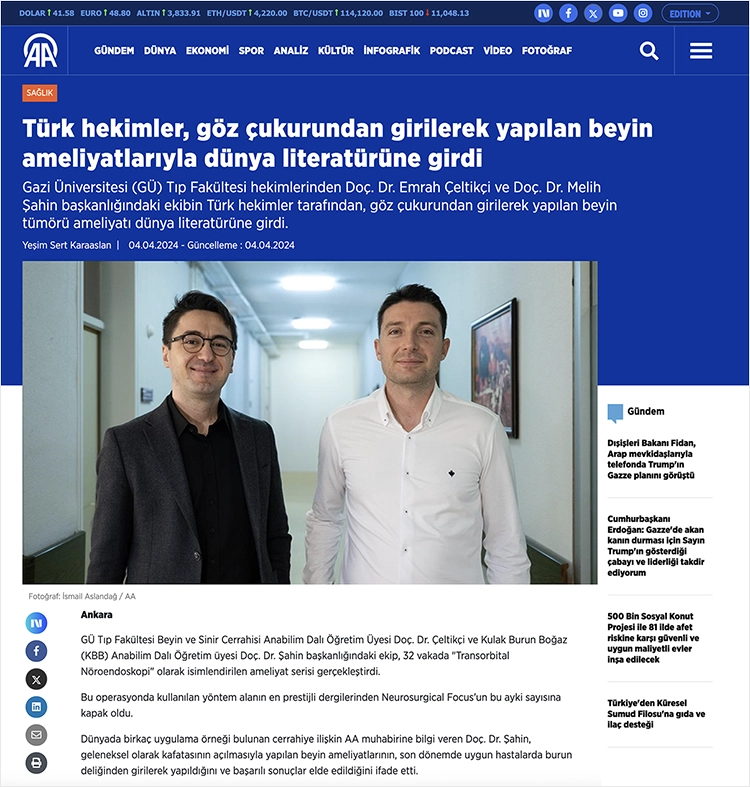
Recalling that tumors located in the region known as the “skull base” can, when suitable, be removed through the nose using an endoscope, Dr. Şahin noted that with new technology, different applications in brain tumor surgery have now become possible.
Previously, tumors situated behind the eye and adjacent to the brain were treated by opening the skull, Dr. Şahin explained, providing the following details:
“Now, we can perform brain surgery through the eye socket. Using this method, we preserve the patient’s eye and vision, making a small incision of only about 3–4 centimeters at the edge of the eye, and use the eye socket as a corridor to quickly access and remove the tumor in that area.
The surgery is performed under general anesthesia and lasts approximately three hours. The most important criterion for this method is the suitability of the tumor’s location, as it must be accessible via the corridor through the eye socket.”
Emphasizing the significant advantages over open surgery, Dr. Şahin added: “With this method, the duration of surgery and hospital stay is reduced. Since the procedure is performed through a small incision—almost like an eyelid cosmetic surgery—without cutting the skull bone, it leaves no visible scar. The patient’s need for blood transfusions and risk of infection are also greatly reduced.”
“Our publication appeared on the cover of the journal”
Associate Professor Dr. Çeltikçi noted that this technique was introduced to the world through a scientific study. He emphasized that these surgeries are a team effort, requiring both neurosurgery and ENT specialists to operate together. Çeltikçi explained that the method was successfully implemented in Turkey through the coordinated work of two departments at Gazi University Faculty of Medicine.
He added:
“The success we achieved was recognized in Neurosurgical Focus, a journal of the American Association of Neurological Surgeons, one of the most prestigious international publications in the field. For a study to be accepted in this journal, strict criteria must be met: each case is examined individually, and the procedure must be performed based on evidence and fully comply with international standards. All these criteria were fulfilled, and our series of brain tumor surgeries performed via the eye socket was accepted and published as a scientific article in the journal.”
Çeltikçi stated that the method was first defined by Italian researchers, but apart from a few limited applications, no case series had yet been published in the literature. He explained:
“Together with Associate Professor Dr. Melih Şahin, we started performing this procedure and have completed 33 cases so far. Upon reviewing the literature, we found that no scientific case series had been published. We presented our surgical experience, covering 32 cases, to the scientific community. Our publication not only got accepted by one of the most prestigious journals in the field but also became the largest case series in the world on this subject and appeared on the cover of the journal. This is highly significant because appearing on the cover of such journals is extremely difficult.”
“Italian physicians will come to Turkey for the next case”
Çeltikçi mentioned that the Italy-based transorbital neuroendoscopy study group had reported performing 14 cases, and after the publication, Italian doctors contacted them to observe the surgery in Turkey. He stated that they are in communication with the Italian colleagues, who will travel to Turkey for the first case.
Reflecting on the pride and honor of presenting Turkey’s achievements to the world through this new study, Çeltikçi concluded:
“We are proud and feel like someone who has won a gold medal at the Olympics.”